
Fashion moves quickly. One month, oversized tailoring is everywhere; the next, social media announces that fitted jackets are back and everything else is outdated.
Trying to keep up can leave you with a crowded wardrobe, less money, and no clear idea of what you genuinely enjoy wearing.
Learning how to find your personal style without following every trend means shifting your attention from what is currently popular to what consistently works for your lifestyle, comfort, body, and personality.
Personal style is not a strict uniform, and you do not have to choose one aesthetic label forever. It is simply a recognisable pattern in the colours, shapes, fabrics, and details that make you feel like yourself.
Research into clothing and self-concept suggests that personal style can reflect someone’s real, ideal, and creative identity. Getting dressed is therefore more than decoration; it can become a practical form of self-expression.
Start With the Clothes You Already Wear
The fastest way to understand your personal style is not to go shopping. It is to study the clothes you already choose repeatedly.
Identify the pieces you wear during ordinary weeks, not the items saved for an imaginary future version of yourself. Look at your favourite trousers, shirts, dresses, jackets, shoes, and accessories. Ask what they have in common.
Perhaps you consistently choose relaxed trousers, simple tops, neutral shades, and one interesting accessory. You may prefer fitted waists, soft fabrics, monochrome outfits, oversized layers, or comfortable sneakers.
Examine the clothes you avoid as well. A blazer may look impressive on the hanger but feel too formal for your routine. A bright dress may fit well but make you feel self-conscious.
These observations are valuable because authentic style is built around your real habits rather than fantasy shopping.
Separate Personal Style From Fashion Trends
Trends are not automatically bad. They can introduce you to new colours, proportions, and styling ideas. The problem starts when every trend is treated like an instruction.
Research comparing style orientation and fashion orientation suggests that both can express identity, but they represent different relationships with clothing.
Personal style develops through repeated preferences, while trend-led dressing changes more closely with whatever is currently being promoted.
Before buying a trending item, ask whether you would still like it without seeing it repeatedly online. Then consider whether it works with at least three pieces you already own and suits your daily activities.
A trend that passes those tests may become part of your signature look. One that only feels exciting because everyone else is wearing it can stay in the shop.
Choose Three Words to Guide Your Wardrobe
Choose three words that describe how you want your clothes to look and feel. They should be specific enough to guide decisions but flexible enough to work across different occasions.
Your words might be “relaxed, polished, creative.” Another person may choose “minimal, practical, soft,” while someone else prefers “bold, tailored, modern.”
Use these words when evaluating outfits. A loose linen shirt may feel relaxed and polished, while colourful jewellery supplies the creative element. A structured jacket may feel tailored and modern, while sneakers keep it practical.
Your words can change as your life evolves. Their purpose is not to trap you inside one aesthetic. They simply provide a useful filter when your wardrobe or shopping options feel overwhelming.
Create Reliable Outfit Formulas
People with recognisable style do not necessarily invent a completely different outfit every morning. They often repeat combinations they already know work.
An outfit formula is a general structure rather than one exact outfit. It could be wide-leg trousers, a fitted top, and simple sneakers. Another formula might combine a midi skirt, tucked-in shirt, and flat shoes.
Create three or four formulas for the situations that appear most often in your life, such as work, weekends, social events, or hot weather. Keep the basic proportions familiar while changing colours, materials, layers, and accessories.
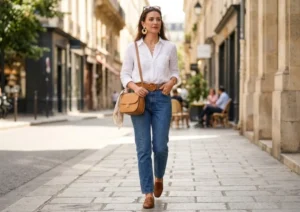
For example, the same jeans-and-shirt formula can look minimal with white sneakers, polished with loafers, or more expressive with a printed scarf and bold jewellery.
Repeating a successful structure saves time without making your wardrobe boring. In fact, repetition is often what makes someone’s style recognisable.
Build a Practical Colour Palette
A personal colour palette makes your wardrobe easier to combine, but it does not have to follow strict seasonal colour rules. Start with the shades you already enjoy wearing.
Choose several foundation colours, such as navy, black, brown, cream, grey, olive, or denim blue. Add two or three accent shades that bring energy and personality to your outfits.
Your palette can be bright, neutral, dark, pastel, or mixed. What matters is that most colours coordinate and that you feel comfortable wearing them.
Pay attention to contrast too. Some people prefer quiet combinations such as beige with cream, while others feel more confident in black and white or strong colour blocking.
Before buying something, imagine it beside your current wardrobe. A beautiful colour that coordinates with nothing you own may create more frustration than value.
Use Inspiration Without Copying Everything
Style inspiration can help you discover your preferences, but it should not become a shopping list. Save images from films, magazines, street style, social media, art, or people whose clothing interests you.
Once you have collected several examples, look for repeated features. You might notice long coats, rolled sleeves, earthy colours, gold jewellery, structured bags, or a mixture of casual and tailored pieces.
Instead of buying the exact products in each image, identify the principle you like. It may be the colour combination, the balance between loose and fitted shapes, or the contrast between a casual outfit and polished accessories.
Recreate that principle using clothes you already own. Inspiration becomes personal when you interpret it rather than copying it from head to toe.
Shop for Wardrobe Gaps, Not Temporary Excitement
Once you understand your preferences, shopping becomes more focused. Instead of asking, “What is new?” ask, “What is missing from the outfits I already want to wear?”
Keep a short list of actual wardrobe gaps. You may need comfortable black trousers, a lightweight jacket, or shoes that work with several dresses. This is more useful than browsing without a purpose.
Consider cost per wear as well. An $80 jacket worn 80 times costs $1 per wear, while a $25 trend item worn twice costs $12.50 per wear. A higher price does not guarantee quality, but repeated use gives a purchase greater practical value.
Keeping clothes in active use for longer can also reduce their environmental impact. WRAP highlights the benefits of extending garment life, while circular-fashion organisations encourage repair, resale, reuse, and longer wear.
Prioritise Fit, Comfort, and Real Life
An item can match your preferred aesthetic and still be wrong if it pinches, slips, scratches, or requires constant adjustment.
When trying on clothes, sit, walk, reach, and bend instead of only standing in front of a mirror. Consider your climate, transportation, workplace, and typical level of activity.
Ignore the size label when possible. Sizing varies between brands, while proper fit determines whether you will actually wear something.
Allow your personal style to change gradually as your work, body, location, or preferences evolve. Experiment by borrowing pieces, shopping second-hand, altering clothes you own, or testing a new silhouette through accessories.
The fashion industry faces problems related to overproduction and overconsumption, so using trends selectively can support both a clearer wardrobe and more thoughtful buying habits.
Finding your personal style is less about choosing the perfect aesthetic and more about paying attention. Study the clothes you already wear, identify repeated colours and shapes, create reliable outfit formulas, and use three descriptive words to guide your choices.
Trends can still be enjoyable, but they should enter your wardrobe because they suit you-not because an algorithm has repeated them enough times. Prioritise fit, comfort, versatility, and the life you actually live.
Start today by choosing five outfits that make you feel most like yourself. Photograph them, note what they share, and use those patterns as your personal style guide. The clearer your preferences become, the easier it will be to get dressed and leave unnecessary trends behind.