
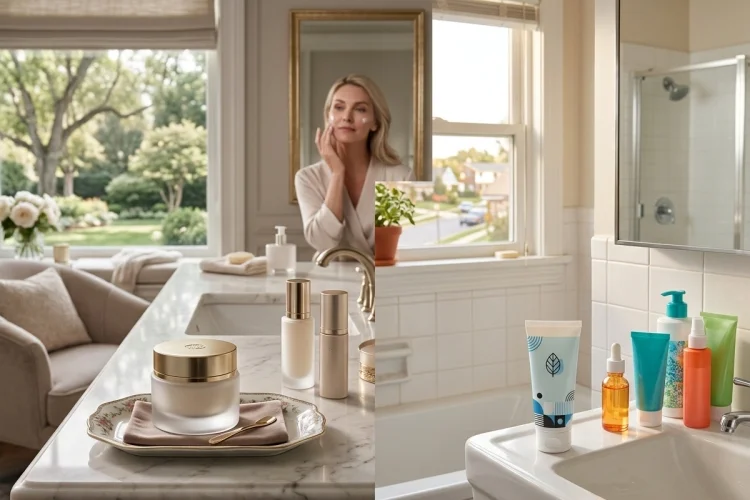
A $150 moisturizer and a $15 moisturizer can sit on the same shelf promising hydration, smoother texture, and healthier-looking skin. Their ingredient lists may even look surprisingly similar.
So, is the expensive option secretly ten times better, or are you mostly paying for a beautiful jar? The answer is more complicated than “luxury skincare is a scam” or “you get what you pay for.”
Price can reflect better packaging, a more elegant texture, specialised formulation technology, additional testing, premium customer service, or simply expensive branding and marketing.
However, a high price alone does not prove that a product will work better for your skin. Understanding expensive versus affordable skincare and what you are paying for can help you shop more confidently.
Instead of judging a serum by its packaging or social media popularity, you can focus on its purpose, ingredients, formulation, and how consistently you will use it.
The best skincare product is not automatically the cheapest or the most luxurious. It is the one that safely addresses your needs, suits your skin, and fits your budget well enough to replace when it runs out.
Does Expensive Skincare Really Work Better?
Expensive skincare can work well, but affordable products can be equally effective. The American Academy of Dermatology states that skincare products do not need to be expensive to work and recommends a simple routine built around cleansing, moisturizing, and sun protection.
Price is not an active ingredient. A luxury cleanser does not automatically remove dirt more effectively, and a premium moisturizer does not necessarily hydrate skin better than a basic cream containing proven humectants, emollients, and occlusive ingredients.
This is especially important for products with simple jobs. A cleanser mainly needs to remove sweat, makeup, sunscreen, and excess oil without causing irritation. A moisturizer should help reduce water loss and support a comfortable skin barrier.
That does not make every affordable product excellent or every expensive formula unnecessary. It simply means that performance must be evaluated separately from price.
What Can Make a Skincare Formula More Expensive?
A skincare product is more than its headline ingredient. The complete formula includes the active or featured ingredients, preservatives, stabilisers, emulsifiers, solvents, texture-enhancing materials, and the base that carries everything onto the skin.
1. Formulation and Delivery Systems
Two products may both contain vitamin C, retinol, or niacinamide but perform differently. The concentration, pH, ingredient form, stability, and surrounding formula can influence how comfortable and useful the product is.
The product’s vehicle-the cream, lotion, gel, ointment, or serum carrying its ingredients-can affect distribution, skin contact, ingredient stability, and user experience.
Research on topical vehicles shows that the base can influence potency, effectiveness, and whether people use a product consistently.
Some brands invest in encapsulation or other delivery technologies designed to protect unstable ingredients or release them gradually. These systems may cost more to develop and manufacture, although sophisticated technology is not automatically necessary for every skincare goal.
2. Texture and Cosmetic Elegance
A more expensive formula may spread more smoothly, absorb faster, smell more appealing, pill less under sunscreen, or leave less visible residue. These qualities do not always change the biological effect, but they can make a product more enjoyable to use.
Enjoyment has practical value. A sunscreen with an elegant finish may be worth more to you when it is the only one you will apply generously every morning.
However, texture is personal. A rich luxury cream may feel beautiful on dry skin but unpleasantly heavy on someone with an oily complexion.
Are You Paying for Better Ingredients?
Sometimes, but not always. Premium products may contain costly botanical extracts, peptides, patented compounds, specialised retinoids, or difficult-to-stabilise antioxidants.
The presence of an expensive ingredient does not reveal whether it is included at a useful level. Cosmetic ingredient lists are generally arranged in descending order of predominance, but ingredients present at 1% or less can be listed in any order after higher-concentration ingredients.
This means you cannot always calculate exact concentrations by reading the label. A fashionable ingredient near the end of the list may be present in a small amount, although some ingredients can still be useful at low concentrations.
It is also possible for an affordable product to contain an evidence-backed active ingredient in an effective formula. Retinol, salicylic acid, benzoyl peroxide, glycerin, ceramides, petrolatum, and niacinamide are not valuable only when placed inside luxury packaging.
Focus on whether the product is designed for your concern. A simple fragrance-free moisturizer may be more helpful for sensitive skin than a premium cream containing numerous extracts and essential oils.
How Much Does Packaging Matter?
Packaging can serve a real purpose. Opaque bottles may protect light-sensitive ingredients, while pumps and airless containers can reduce repeated exposure to air and fingers.
This matters for ingredients that degrade when exposed to oxygen, heat, or light. Formulation and packaging technologies may improve stability, control delivery, and help the product remain usable throughout its intended shelf life.
Still, not every heavy glass jar represents advanced protection. Sometimes the packaging is designed mainly to feel luxurious on a dressing table.
A beautiful container, magnetic lid, decorative box, or included applicator adds to production and shipping costs. You may enjoy those details, but they do not automatically improve the product inside.
Consider whether the packaging protects the formula or simply increases its visual appeal. Both can have value, but they are different kinds of value.
How Much of the Price Is Branding and Marketing?
Part of a premium product’s price may support advertising campaigns, celebrity partnerships, influencer promotion, luxury retail spaces, elaborate packaging, samples, and brand image.
These expenses can make a product more desirable without making its formula proportionally more effective. Luxury brands often sell an experience as well as a cream or serum.
Marketing language can also sound more scientific than the evidence behind it. Terms such as “clinically inspired,” “detoxifying,” “age-reversing,” and “professional strength” do not provide enough information on their own.
In the United States, cosmetic claims must be truthful and not misleading. A product marketed as treating disease or changing the body’s structure or function may legally be considered a drug and must meet the relevant drug requirements.
The Federal Trade Commission also expects health-related advertising claims to have suitable scientific support.
Evidence for an ingredient does not automatically prove that every product containing it delivers the same result. The formulation, dose, testing method, and advertised benefit must match the evidence being used.
When Affordable Skincare Is Usually Enough
Basic products are often excellent places to save money. Gentle cleansers, straightforward moisturizers, petrolatum-based balms, and uncomplicated body lotions do not require luxury positioning to perform their main functions.
Affordable sunscreen can also provide effective protection when it has the appropriate broad-spectrum SPF and is used correctly. Sunscreen labels are subject to specific testing and labelling rules, including tests for SPF and broad-spectrum claims.
The sunscreen you can afford to apply generously and replace regularly may be more useful than an elegant product you use sparingly because the bottle is expensive.
Drugstore skincare is also useful when you are testing a new routine. Starting with affordable basics makes it easier to identify what your skin actually needs before investing in specialised serums.
You may prefer to save on cleanser and moisturizer while spending more on a sunscreen texture you love or a treatment recommended by a dermatologist.
When Paying More May Be Worth It
A premium product may be worth the cost when it solves a problem that cheaper alternatives have not addressed. Perhaps it is the only sunscreen that does not sting your eyes, the only moisturizer that sits comfortably under makeup, or a treatment with a well-designed delivery system.
You may also value extensive brand testing, transparent research, refillable packaging, responsive customer service, or a sensory experience that makes skincare feel enjoyable.
The important question is not whether the product is objectively worth its price to everyone. Ask whether the specific benefit matters enough to you.
Paying more for a texture you love can be reasonable because consistency matters. Paying more solely because the packaging implies that the product is stronger is less convincing.
Remember that irritation is not proof of potency. A premium serum that repeatedly causes burning, redness, or peeling is not a better investment simply because it contains several active ingredients.
How to Compare Expensive and Affordable Products
Begin with the concern you want to address. “I want luxury skincare” is not a specific goal, but “I need a moisturizer that reduces tightness without clogging my pores” gives you something useful to evaluate.
Next, compare the active or evidence-supported ingredients, overall formula, packaging, quantity, and directions. Calculate the price per ounce or millilitre rather than looking only at the price on the front of the box.
Consider how the product fits into your routine. A concentrated treatment used twice a week may last longer than a moisturizer applied generously morning and night.
Ignore dramatic claims that do not explain how the result was measured. A statement such as “90% of users said their skin felt softer” provides different evidence from a controlled clinical study showing a measurable change.
Introduce one product at a time and patch-test it when possible. This helps you identify irritation and prevents a large, expensive routine from becoming impossible to evaluate.
Finally, give suitable products enough time to work. Moisturizers may improve comfort quickly, while concerns such as uneven tone, acne, or fine lines often require consistent use over a longer period.
Build a Routine Based on Value, Not Status
A sensible skincare budget does not have to be completely affordable or completely luxurious. You can combine basic drugstore products with one or two premium items that provide a meaningful benefit.
Spend according to function. Products that remain on the skin, contain treatment ingredients, or strongly affect whether you follow the routine may deserve more consideration than products you quickly rinse away.
Keep the routine simple enough to monitor. Dermatologists warn that using too many products can increase both cost and irritation.
Your skin cannot see the logo on the bottle. It responds to the formula, how you use it, and whether the product suits your individual needs.
The difference between expensive and affordable skincare is not always the difference between effective and ineffective. A higher price may cover specialised formulation, stability testing, sophisticated packaging, pleasant texture, marketing, retail costs, or brand prestige.
Affordable products can still provide excellent cleansing, moisturizing, treatment, and sun protection. Premium skincare may be worthwhile when its formula, finish, packaging, or tolerability gives you a benefit you cannot easily find elsewhere.
Before your next purchase, identify the result you need, compare the complete formulas, calculate the cost per ounce, and look beyond dramatic advertising. Spend more where the difference genuinely improves your routine, but never assume that a luxury price guarantees luxury results.