
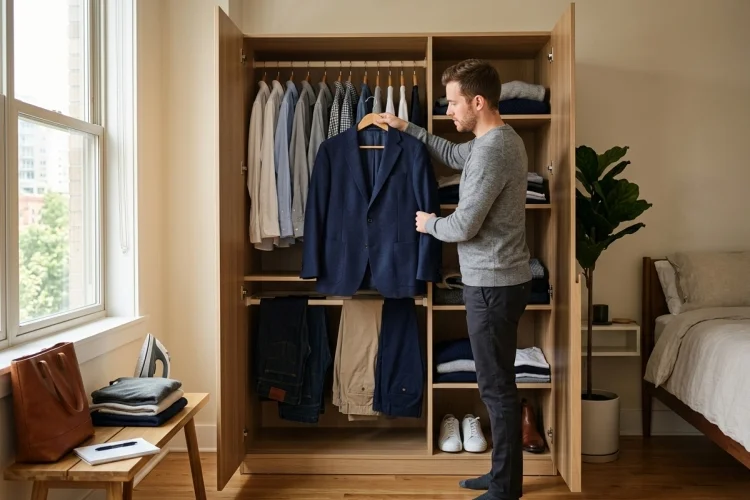
Building a wardrobe from scratch sounds exciting until you start shopping. Suddenly, every shirt seems essential, every pair of shoes serves a different purpose, and social media is convincing you that last month’s trousers are already outdated.
A practical wardrobe does not need to contain dozens of expensive pieces. It needs enough clothing to cover your real week, from ordinary workdays and relaxed weekends to occasional dinners, interviews, or formal events.
Learning how to build a practical men’s wardrobe from scratch is mainly about making each purchase work harder. Instead of collecting unrelated items, you choose clothes that fit properly, coordinate easily, and suit your climate, workplace, budget, and personal style.
The goal is not to create a strict uniform or copy someone else’s capsule wardrobe exactly. It is to build a reliable foundation that makes getting dressed easier.
Once that foundation is working, you can gradually add more colour, personality, and variety without wasting money on clothes you rarely wear.
Begin With Your Actual Lifestyle
Before making a shopping list, think about how you spend an ordinary month. Your wardrobe should reflect your current routine rather than the life you imagine having someday.
Someone working in a conservative office may need several button-down shirts, tailored trousers, and smart shoes. A remote worker in a warm climate will probably get more use from breathable T-shirts, casual shirts, comfortable trousers, and clean sneakers.
Divide your typical activities into broad categories such as work, casual time, exercise, social occasions, and formal events. Then estimate how often each category appears.
You do not need five suits when you attend one formal event every two years. Similarly, buying ten graphic T-shirts will not solve your wardrobe problem when your workplace requires business-casual clothing.
Start with the category you use most frequently. That is where the majority of your initial budget should go.
Choose a Simple and Flexible Colour Palette
A coordinated colour palette makes a small wardrobe feel much larger. When most of your tops work with most of your trousers, you can create more outfits from fewer items.
Begin with two or three neutral foundation colours. Navy, charcoal, grey, white, cream, olive, brown, black, and denim blue are popular because they generally combine easily.
You do not need to wear only neutrals. Add one or two accent colours that suit your preferences, such as burgundy, forest green, rust, pale blue, or mustard.
For example, navy trousers can work with white, grey, light blue, cream, or burgundy tops. A bright purple pair of trousers may be more difficult to repeat unless bold colour is already an important part of your style.
Keep patterns simple at the beginning. Solid colours, narrow stripes, subtle checks, and understated textures are easier to combine than several competing prints.
Buy Versatile Wardrobe Essentials First
There is no universal list that fits every man, but most starter wardrobes benefit from several adaptable categories. GQ has demonstrated that a functional men’s capsule wardrobe can be built around a relatively small group of versatile pieces rather than an enormous closet.
1. Start With Everyday Tops
Choose four to six plain T-shirts or polo shirts in colours that suit the rest of your wardrobe. Look for fabric that feels comfortable and is thick enough to hold its shape without being unnecessarily heavy.
Add two or three casual button-down shirts. An Oxford shirt, linen-blend shirt, or simple overshirt can be worn open over a T-shirt, buttoned on its own, or layered under a jacket.
If your work environment is formal, increase the number of dress shirts. White and light blue are dependable starting points because they coordinate with many suits, jackets, and trousers.
2. Add Reliable Trousers
Begin with one dark pair of jeans, one pair of chinos, and one pair of smarter trousers. Depending on your lifestyle, you might replace the formal trousers with another pair of casual pants or durable workwear-inspired trousers.
Dark, minimally distressed jeans can be worn with a T-shirt and sneakers or dressed up slightly with a button-down shirt and leather shoes. Neutral chinos provide a useful middle ground between denim and formal tailoring.
Choose cuts that feel current without being extreme. A straight or gently tapered shape is usually easier to wear for several years than an aggressively skinny or dramatically oversized fit.
3. Select Useful Layers
Your first layer should suit your climate. It might be an unstructured blazer, lightweight bomber, denim jacket, overshirt, cardigan, rain jacket, or wool coat.
A navy or charcoal blazer is especially useful when you need to look polished without wearing a full suit. It can work with tailored trousers, chinos, or dark jeans.
People living in hot climates may get more value from lightweight overshirts and breathable jackets. There is no reason to buy a heavy coat simply because it appears on a traditional wardrobe checklist.
Prioritise Fit Before Brand Names
An affordable shirt that fits properly will usually look better than an expensive designer shirt with awkward proportions.
Check the shoulders first. The shoulder seam should generally sit close to the edge of your natural shoulder rather than hanging far down the arm or pulling toward your neck.
Shirt sleeves should allow comfortable movement without covering most of your hands. Trousers should stay in place without a tightly fastened belt and should not pull heavily across the hips or thighs.
Pay attention to length as well. A casual untucked shirt should not look like a short dress, while a shirt designed for tucking needs enough length to remain inside the trousers when you move.
Do not become overly attached to the size printed on the label. Sizing varies between brands, so judge each garment by how it sits on your body.
Simple alterations can improve an otherwise good item. Hemming trousers or shortening sleeves may be worth the extra cost, particularly for clothes you expect to wear frequently.
Build a Small but Useful Shoe Collection
You do not need a different pair of shoes for every outfit. Two or three carefully chosen pairs can handle most situations.
Start with clean, simple casual shoes. Minimal sneakers in white, grey, navy, brown, or black can work with jeans, chinos, casual trousers, and some relaxed suits.
Your second pair should cover smarter occasions. Loafers, Derby shoes, Oxford shoes, or understated leather boots can work depending on your workplace and preferred level of formality.
Choose black when you regularly wear black, charcoal, or formal navy clothing. Brown or dark burgundy can be more flexible with denim, beige chinos, olive trousers, and less formal tailoring.
The third pair should address a practical need. This might be running shoes, weather-resistant boots, sandals, or work-specific footwear.
Match your belt to the general colour family of your leather shoes when dressing formally. For casual outfits, the match does not need to be exact.
Create Repeatable Outfit Formulas
A practical wardrobe becomes easier to use when you develop a few reliable outfit formulas. These are simple combinations you can repeat with different colours and fabrics.
A casual formula might be a plain T-shirt, dark jeans, clean sneakers, and an overshirt. A business-casual version could combine chinos, an Oxford shirt, loafers, and an unstructured blazer.
For a relaxed weekend, try a polo shirt, lightweight trousers, and simple sneakers. For a smarter evening, wear dark jeans or tailored trousers with a button-down shirt and leather shoes.
These formulas remove much of the daily decision-making. They also reveal which wardrobe gaps are real.
When you repeatedly think, “This outfit needs a lighter jacket,” that may be a useful purchase. When you simply feel bored while browsing an online sale, you probably do not need another shirt.
Set a Realistic Budget and Buy Gradually
Building everything in one shopping trip is rarely necessary. It can also lead to rushed decisions because you have not yet learned which cuts, fabrics, and colours you enjoy wearing.
Set a total budget, then divide it by priority. Spend first on items you will wear often, such as shoes, trousers, jackets, and everyday shirts.
Cost per wear can make the decision clearer. A $120 jacket worn 120 times costs $1 per wear. A $35 trend-driven shirt worn twice costs $17.50 per wear.
That does not mean expensive clothing is always better. Examine the seams, buttons, fabric, zipper, lining, and care requirements rather than assuming a high price guarantees durability.
Second-hand shops and resale platforms can be useful for jackets, coats, quality knitwear, denim, and formal clothing. Just make sure the condition and fit are good enough that you will genuinely use the item.
Buying fewer, more useful garments can also keep clothes in active use for longer. WRAP reports that extending clothing life can reduce the environmental footprint associated with producing and replacing garments.
UNEP similarly promotes durable clothing, reuse, and repair as part of reducing fashion waste and overconsumption.
Check Fabric, Construction, and Care Requirements
Fabric affects comfort, appearance, durability, and maintenance. Cotton can be breathable and easy to wear, while wool provides warmth and natural structure.
Linen performs well in heat but wrinkles easily, which may be either charming or annoying depending on your preference.
Synthetic fibres can improve stretch, wrinkle resistance, and durability, although quality varies. A blended fabric is not automatically worse than a completely natural one.
Look at the stitching and seams. Loose threads, uneven stitching, thin fabric around stress points, and weak buttons may signal that the garment will require repairs sooner.
Read the care label before buying. In the United States, most textile clothing must include care instructions so consumers know how to clean and maintain the garment safely.
A “dry clean only” jacket may be appropriate for occasional formal wear, but it might be inconvenient as your main weekly layer. Choose maintenance requirements that fit your time and budget.
Wash clothes according to their labels, avoid laundering lightly worn items unnecessarily, and repair loose buttons or small tears early. Basic care can help a practical wardrobe remain useful for longer.
Add Personality After the Foundation Works
A practical wardrobe should not feel generic forever. Once you have reliable basics, add details that make the clothes feel more personal.
You might prefer textured knitwear, vintage jackets, colourful socks, patterned shirts, jewellery, watches, boots, or bold outerwear. Add these pieces gradually so they complement rather than compete with your foundation.
One statement item usually has more impact when the rest of the outfit is simple. A patterned jacket can work with a plain shirt and dark trousers, while colourful sneakers can add interest to a neutral casual look.
Ignore any “essential” that does not suit you. You do not need polo shirts if you dislike collars, white sneakers if you hate cleaning them, or a leather jacket if it feels completely wrong for your personality.
A successful wardrobe should make you feel comfortable and prepared, not dressed as someone else.
Building a practical men’s wardrobe from scratch is not about owning every classic menswear item. It is about choosing enough versatile clothing to support your real lifestyle.
Start with a coordinated colour palette, comfortable everyday tops, adaptable trousers, practical layers, and two or three useful pairs of shoes. Prioritise fit, examine construction, and buy gradually rather than filling the closet in one weekend.
Begin today by writing down the five situations you dress for most often. Then identify the minimum pieces needed to create several outfits for each one.
Buy the most important missing item first, wear it regularly, and let your experience guide the next purchase. A strong wardrobe grows through useful decisions, not random shopping.