“Smart casual” might be one of the most confusing phrases in menswear.
You receive an invitation saying the dress code is smart casual. Suddenly, you are staring at your wardrobe wondering whether jeans are acceptable, whether you need a blazer, and whether clean sneakers count as “smart.”
The good news is that smart-casual menswear is much simpler once you stop treating it as a strict uniform. It sits somewhere between relaxed everyday clothing and traditional formalwear.
The goal is to look polished and intentional without appearing as if you are heading to a board meeting or wedding ceremony.
Esquire describes smart casual as a middle ground that combines casualwear with smarter pieces, while MR PORTER similarly frames modern smart casual as the space between very relaxed clothing and traditional suit-and-tie dressing.
In practice, getting it right is mostly about balance, fit, fabric, footwear, and understanding where you are going.
What Does Smart Casual Actually Mean?
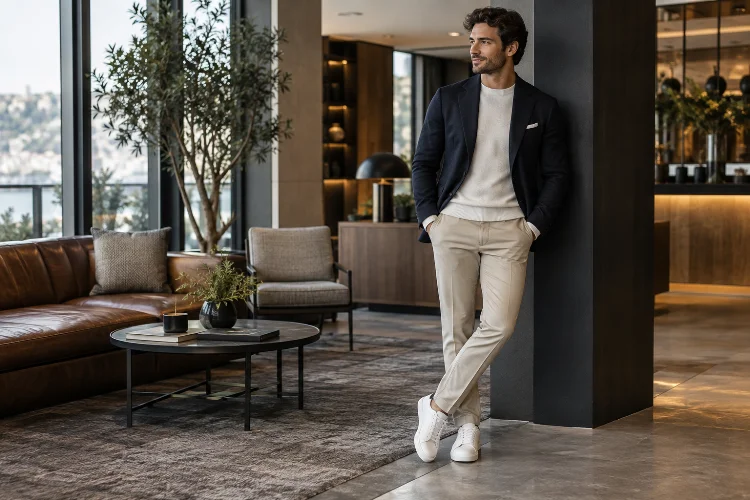
Smart casual is best understood as “casual clothing with more polish.”
Imagine your normal weekend outfit: T-shirt, jeans, and sneakers. Now improve one or two parts. Replace the T-shirt with an Oxford shirt, the faded jeans with tailored trousers, or the everyday sneakers with loafers.
Suddenly, the outfit feels sharper without becoming formal.
Debrett’s points out that the meaning can also change depending on the event. More traditional occasions may expect a blazer, collared shirt, chinos or trousers, and smart footwear, while modern interpretations can be considerably more relaxed.
That flexibility is why there is no single perfect smart-casual outfit.
Context matters.
Smart Casual vs Casual: Where Is the Difference?
Casual clothing prioritises comfort and usually has fewer rules.
Think hoodies, graphic T-shirts, distressed jeans, athletic shoes, shorts, and relaxed sportswear. These clothes can look great, but they do not automatically communicate the polished appearance usually expected from smart casual.
Smart casual takes those relaxed foundations and cleans them up.
A plain heavyweight T-shirt can work. A graphic tee covered in oversized logos may be harder to style. Dark jeans can fit perfectly into the dress code, while heavily ripped denim usually pulls the outfit too far towards casual.
The key word is intentional.
Your clothes should look chosen rather than simply grabbed from the nearest chair.
Smart Casual vs Business Casual
These two dress codes overlap, which explains much of the confusion.
Business casual traditionally focuses on workplace clothing. Chinos, tailored trousers, Oxford shirts, loafers, knitwear, and relaxed blazers are common choices.
Smart casual gives you more freedom.
You might wear clean sneakers instead of Derby shoes, a knitted polo instead of a button-down, or dark jeans instead of office trousers.
Modern workplaces have also become less rigid. GQ notes that many offices now allow considerably more individuality than traditional business dress codes once did.
A useful rule is this: business casual asks, “Does this look appropriate for work?” Smart casual asks, “Does this look polished enough for the occasion without becoming formal?”
The two can look very similar, but their purpose is slightly different.
The Essential Smart-Casual Menswear Pieces
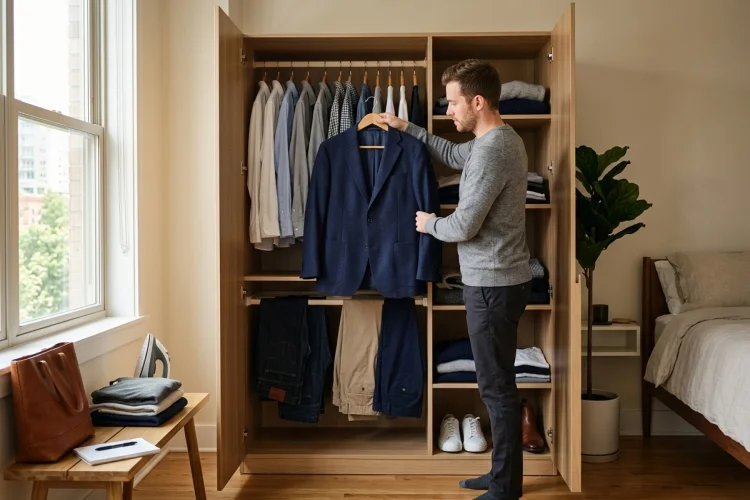
You do not need an enormous wardrobe to dress this way.
A small collection of versitile basics can create dozens of combinations.
Start with well-fitting trousers or chinos, dark denim, plain T-shirts, Oxford shirts, knitted polos, crew-neck sweaters, and perhaps an unstructured blazer.
GQ’s current wardrobe essentials similarly emphasise enduring basics such as a white T-shirt, jeans, a navy blazer, crew-neck knitwear, chinos, and adaptable footwear as foundations of a practical men’s wardrobe.
Choose Softer Tailoring
A heavily structured business suit jacket can look strange with casual trousers.
An unstructured blazer is easier.
It usually has less padding and a softer shape, which makes it work naturally with chinos, jeans, knitwear, and even a high-quality T-shirt.
MR PORTER’s modern smart-casual guidance similarly favours softer trousers, relaxed tailoring, and comfortable layers rather than rigid business dressing.
Think relaxed sophistication rather than corporate uniform.
Can You Wear Jeans for Smart Casual?
Yes – but the type of jeans matters.
Dark indigo, black, or clean mid-blue denim is generally easier to dress up than heavily washed or distressed styles. Straight or gently tapered cuts are particularly flexible.
Try dark jeans with a light blue Oxford shirt, brown loafers, and a navy blazer.
Another simple combination is dark denim, a knitted polo, and minimalist leather sneakers.
FashionBeans’ smart-casual guide also identifies neat dark jeans as a workable option in less formal interpretations of the dress code.
The main thing that seperates smart denim from casual weekend denim is condition. Excessive fading, holes, paint splashes, or exaggerated details can make the outfit feel too relaxed for some occasions.
Are Sneakers Smart Casual?
Sometimes.
Your running shoes probably are not the best option for a nice restaurant. Clean, understated sneakers can be different.
Minimal leather or suede sneakers in white, cream, brown, navy, or black can sit comfortably beside chinos, tailored trousers, and smart knitwear.
The rest of the outfit matters too.
Sneakers with sweatpants and a hoodie look casual. The same sneakers with tailored trousers, a tucked polo, and a lightweight jacket can feel surprisingly polished.
When you are unsure about the dress code, loafers, suede Derbies, Chelsea boots, or other relaxed leather shoes are safer.
Footwear often determines which side of the smart-casual line an outfit lands on.
Three Easy Smart-Casual Outfit Formulas
You do not need to invent a completely new look every morning.
One reliable formula is Oxford shirt + chinos + loafers. It works for casual offices, lunches, dinners, and many social events. Add an unstructured blazer when you need more polish.
Another is knitted polo + tailored trousers + clean sneakers. This feels more contemporary while still looking intentional.
For cooler weather, try crew-neck sweater + dark jeans + suede boots + structured coat.
These combinations work because each outfit mixes relaxed and polished elements.
FashionBeans recommends a similar strategy: begin with a casual outfit and replace one or two items with smarter alternatives rather than dressing formally from head to toe.
That might be the easiest smart-casual rule to remember.
Fit and Fabric Matter More Than You Think
Two men can wear exactly the same clothing categories and achieve completely different results.
Fit is often the reason.
Your clothes do not need to be extremely slim. Current menswear increasingly embraces straighter, roomier silhouettes. But trousers dragging across the ground, shirts pulling across the buttons, or jackets several sizes too large can make an outfit look accidental.
Fabric also changes the level of formality.
A smooth wool trouser feels smarter than a jersey jogger. A knitted polo looks more refined than a sports jersey. Suede shoes often feel softer and more relaxed than highly polished business shoes.
FashionBeans notes that texture can shift a garment towards either the formal or casual side of menswear.
Smart casual becomes much easier once you begin noticing these details.
What Should You Avoid?
The biggest mistake is going too far in either direction.
A three-piece suit, silk tie, polished Oxfords, and pocket square are probably too formal. At the opposite extreme, gym shorts, flip-flops, stained trainers, and an oversized graphic hoodie are unlikely to qualify.
Avoid assuming that adding a blazer automatically fixes everything.
A blazer over poorly fitting clothes still looks poorly considered.
Also pay attention to condition. Wrinkled shirts, dirty sneakers, stretched collars, and badly worn shoes can undermine an otherwise good outfit.
Small accesories such as a simple watch, belt, or understated bag can help, but they should support the outfit rather than dominate it.
Dress for the Occasion, Not Just the Label
Perhaps the most important smart-casual rule is to think about where you are actually going.
Smart casual at a creative office can be very different from smart casual at an expensive restaurant. A daytime birthday party may allow sneakers and denim, while an evening corporate event could call for trousers, loafers, and a blazer.
Esquire notes that smart casual can cover settings including dinners, dates, workplaces, presentations, and social gatherings, which helps explain why the definition remains flexible.
When uncertain, being slightly smarter is usually easier to manage than being obviously underdressed.
You can remove a blazer or open a shirt collar. Fixing an outfit that is far too casual once you arrive is considerably harder.
Smart-casual menswear is not a rigid list of approved garments. It is a balancing act between comfort and polish.
Start with clean, well-fitting basics. Combine casual pieces such as dark jeans, sneakers, or plain T-shirts with smarter elements like tailored trousers, Oxford shirts, knitwear, loafers, and relaxed blazers.
Most importantly, consider the setting.
A good smart-casual outfit should make you look like you made an effort without making that effort look exhausting. Build two or three dependable combinations from clothes you already own, then adjust the shoes, jacket, and shirt depending on the occasion.
Once you understand that balance, “smart casual” stops being a confusing dress code and becomes one of the most usefull styles in a man’s wardrobe.