
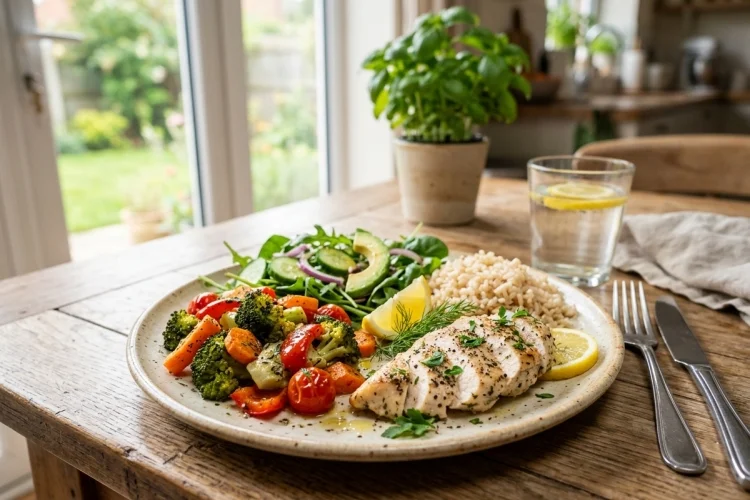
Counting calories can be useful in certain situations, but it is not the only way to improve your eating habits. For many people, tracking every ingredient, measuring every spoonful, and checking nutrition apps before each meal quickly becomes exhausting.
A simpler option is to focus on what your plate looks like. Learning how to build a balanced plate without counting every calorie gives you a practical visual framework for choosing vegetables, carbohydrates, protein, and healthy fats.
You can use it at home, in a restaurant, at work, or while preparing a quick meal from leftovers. This approach is not about creating a nutritionally perfect plate every time you eat. It is about building meals that are varied, satisfying, and realistic enough to repeat.
The NHS Eatwell Guide also notes that dietary balance does not have to be achieved at every individual meal. You can aim for balance across the entire day or even the week.
What Does a Balanced Plate Actually Look Like?
A balanced plate usually contains three main sections: vegetables and fruit, a source of protein, and a carbohydrate-rich food. A small amount of healthy fat may already be included in the ingredients or added during cooking.
A simple visual starting point is to fill approximately half the plate with vegetables and fruit. Divide the other half between protein foods and whole-grain or other high-fibre carbohydrates.
Canada’s Food Guide uses this basic model: half vegetables and fruit, one-quarter whole-grain foods, and one-quarter protein foods. It is intended as a flexible guide rather than a strict mathematical rule.
Your meal might include roasted vegetables, brown rice, and chicken. It could also be a vegetable curry with lentils and whole-grain flatbread, or a stir-fry containing tofu, mixed vegetables, and noodles.
The foods can change depending on your culture, budget, preferences, and local ingredients. The general structure stays useful even when the recipes look completely different.
Fill Half the Plate With Vegetables and Fruit
Vegetables and fruit provide fibre, vitamins, minerals, and a wide range of plant compounds. The World Health Organization recommends eating a variety of nutrient-dense foods and advises people over age 10 to aim for at least 400 grams of fruit and vegetables per day.
You do not need to place six different vegetables on every plate. One large serving of mixed vegetables, a side salad, or vegetables cooked into a sauce can cover a significant part of the meal.
Fresh produce is not your only option. Frozen vegetables, canned tomatoes, canned beans, and fruit packed without large amounts of added sugar can make balanced eating cheaper and more convenient.
WHO guidance recognizes fresh, frozen, and canned produce as useful choices when added sugar and excess sodium are limited.
Try to vary the colours you eat throughout the week. Green spinach, orange carrots, red tomatoes, purple cabbage, and white cauliflower all bring different flavours and nutrients.
Fruit can be included with the meal or saved for later. For example, breakfast might include oats, yogurt, and berries, while lunch could contain mostly vegetables and no fruit at all.
Give Protein a Clear Place on Your Plate
Protein helps make a meal more substantial and supports the maintenance of muscles and other body tissues. Common sources include eggs, fish, poultry, lean meat, yogurt, tofu, tempeh, beans, chickpeas, lentils, nuts, and seeds.
Aim to give protein roughly one-quarter of the plate. You do not need to weigh it unless you have been given a specific target by a healthcare professional.
For a simple hand-based estimate, a portion of meat, fish, tofu, or tempeh might be around the size of your palm. Beans and lentils can occupy a similar section of the plate, although the ideal quantity depends on your appetite and energy needs.
Plant proteins can be especially useful because foods such as beans and lentils also provide fibre. The NHS lists pulses as alternatives to meat and describes them as sources of both protein and fibre.
Protein does not have to dominate the meal. A very large steak with a few decorative vegetables is still an unbalanced plate, even if the meal is high in protein.
Choose Carbohydrates That Offer More Than Energy
Carbohydrates are often treated as foods that must be avoided, but they are an important source of energy. The quality and amount of the carbohydrate usually matter more than simply removing it.
Use approximately one-quarter of the plate for rice, potatoes, pasta, bread, noodles, oats, corn, quinoa, or another starchy food. When practical, choose whole grains or higher-fibre versions.
Examples include brown rice, oats, whole-grain bread, wholewheat pasta, barley, and potatoes with their skins. The NHS recommends basing meals on starchy carbohydrates while choosing whole-grain or higher-fibre varieties when possible.
That does not mean white rice or regular bread can never appear on a balanced plate. You can still create a nutritious meal by pairing them with plenty of vegetables, a suitable protein source, and a reasonable portion.
Harvard’s Healthy Eating Plate also emphasizes the quality of carbohydrates, encouraging whole grains while limiting highly refined options. It does not prescribe a fixed calorie total because individual needs vary.
Add Healthy Fats Without Letting Them Take Over
Fat contributes flavour, texture, and satisfaction. It also helps the body absorb certain vitamins, but fats are concentrated sources of energy, so modest amounts are usually enough.
Healthy fat sources include olive oil, avocado, nuts, seeds, nut butter, and oily fish. You might add a small drizzle of oil to vegetables, sprinkle seeds over a salad, or include avocado in a sandwich.
Remember that fat may already be present in the meal. Salmon, eggs, cheese, nuts, sauces, and cooking oil all contribute, so you do not necessarily need to add another separate fat source.
WHO recommends favouring unsaturated fats found in foods such as fish, avocado, nuts, and several plant oils over saturated and industrially produced trans fats.
The goal is not to make every meal low-fat. It is to choose useful sources and pay attention when oils, dressings, creamy sauces, or fried toppings begin taking up more space than the main ingredients.
Adjust Portions Using Hunger and Fullness
The plate method gives your meal structure, but it cannot measure your personal appetite. A tall, physically active person may require more food than someone smaller or less active.
Start with a balanced plate and eat at a comfortable pace. Notice how hungry you feel before eating, how the meal tastes, and when you begin feeling comfortably satisfied.
You can have more food when you are still genuinely hungry. The purpose of the plate model is not to restrict you to one serving regardless of your needs.
It is also important to understand that the serving size printed on a package is not necessarily a recommendation. The FDA explains that serving sizes on Nutrition Facts labels reflect amounts people typically consume, rather than the exact quantity every individual should eat.
Your portion can change according to your age, body size, activity, health goals, and the rest of your day. Learning to combine visual guidance with internal hunger signals can be more practical than treating a tracking app as the final authority.
Make Mixed Meals Fit the Plate Method
Not every meal arrives as separate piles of vegetables, rice, and protein. Soups, sandwiches, pasta dishes, curries, casseroles, pizzas, and stir-fries combine several food groups.
Instead of forcing these meals into perfect sections, think about their ingredients. Ask whether the dish contains a generous amount of vegetables, a recognizable protein source, and an appropriate carbohydrate.
For pasta, you could use plenty of tomato-based vegetable sauce, add beans, chicken, tuna, or lentils, and serve a smaller amount of pasta alongside a salad.
For a sandwich, choose a filling such as egg, chicken, hummus, tuna, or tofu. Add salad vegetables, use whole-grain bread when available, and include fruit or vegetable soup on the side.
The NHS recommends considering how the ingredients in combination foods fit into the major food groups.
The same idea works for local and traditional meals. You do not need to replace familiar foods with expensive “diet” products. Adjust the proportions using ingredients you already know and enjoy.
Keep the Method Flexible and Realistic
A balanced plate is a guide, not a test that you can fail. Some meals will contain fewer vegetables, while others may be heavier in carbohydrates or protein.
If lunch was mostly bread and cheese, you can include more vegetables and a varied protein source at dinner. Balance is easier to maintain when you look at your overall eating pattern instead of criticizing one meal.
Desserts, takeaway foods, and favourite snacks can still fit into a balanced lifestyle. They do not have to occupy the main part of every meal, but they also do not need to be surrounded by guilt.
Convenience foods can be improved rather than completely avoided. Add frozen vegetables to instant noodles, serve a ready-made meal with salad, or combine canned soup with whole-grain toast and a boiled egg.
People with allergies, digestive disorders, diabetes, kidney disease, pregnancy-related needs, eating disorders, or other medical concerns may need individualized advice.
The NHS recommends consulting a registered dietitian when special dietary or medical requirements affect how general food guidance should be applied.
Building a balanced plate does not require weighing every ingredient or knowing the calorie content of every meal.
Start by filling about half your plate with vegetables and fruit, then divide the remaining space between protein and a carbohydrate-rich food. Include a modest amount of healthy fat and adjust the quantity to match your appetite.
The method should remain flexible. Your meals can reflect your culture, budget, schedule, and favourite foods without looking like a carefully arranged nutrition poster.
At your next meal, look at your plate before reaching for a tracking app. Identify one missing element and add it-a vegetable, a protein source, or a higher-fibre carbohydrate.
Small changes to the structure of your meals can make balanced eating feel much more natural.